
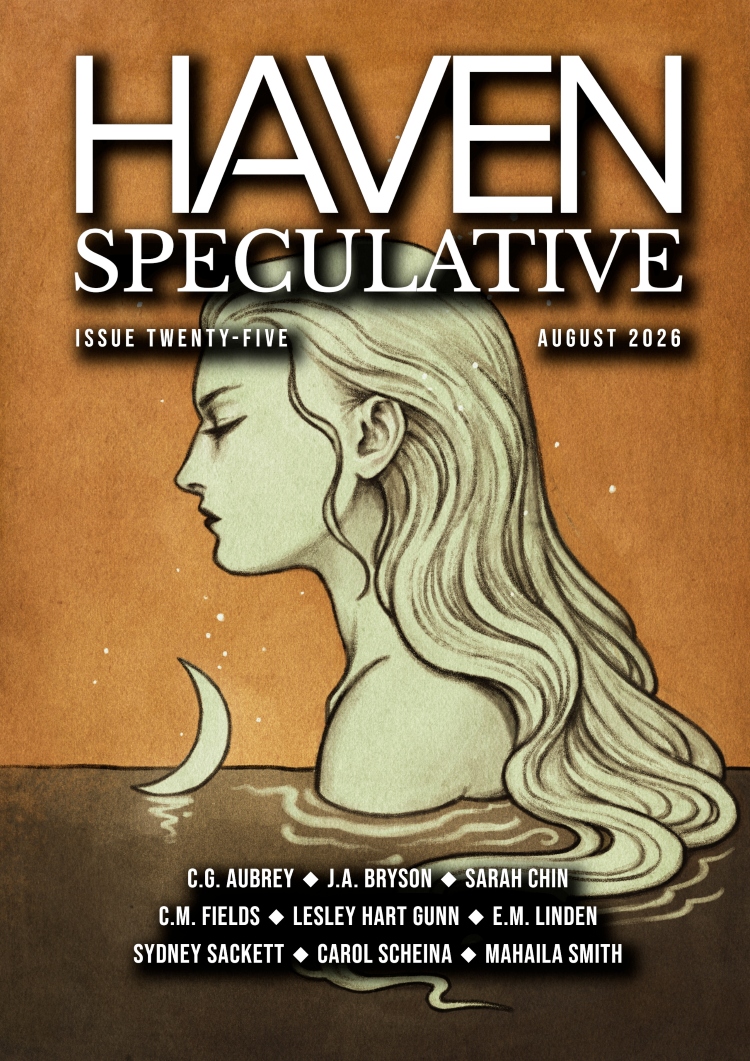
fiction
The Forest, the Sea, & Those Caught Between
by C.G. Aubrey in Issue Twenty-Five, August 2026
3097 words
“Once, now, and always,” begin all of her Zaza’s tales. Bren knows every one by heart, but she still loves the rise and fall of every sun-drenched, salt-crusted story, Zaza’s rich voice rolling like waves. “Three children drift on a cold, dark sea.”
This is Bren’s favorite. Even her brother Walt, who at fourteen sees himself as far too old for such nonsense, stops on his way to bed and leans in the open door of Bren and Aggie’s bedroom.
“Were they lost?” Walt asks, lips twitching. He knows they were. Knows in some ways they still are. The sea is in their blood, on Zaza’s side, but the forest is too, on Mama’s. The Murphy children feel the pull between like a spring tide, birth and rebirth ever insistent.
“They were,” Bren replies.
Once, now, and always.
Zaza says that “once upon a time” is for people who’ve lost their history, for people who only find the truth in stories after they’ve drowned first in fickle fiction.
Bren’s just turned ten and not entirely certain about that last but she likes saying it, feels a kinship to complicated tales. She’s been called fickle often enough, and shallow too. No one knows there is an ocean inside her, mercurial, fathomless, even to her.
“Were they siblings?” Aggie chirps, eyes wide enough to hold the heavens, or a single heartfelt wish.
This is the right question and Zaza smiles as they tuck Bren and Aggie beneath a faded quilt of sawtooth stars. The constellations are sea-hued and threadbare, but Zaza says they will still lead Bren home, should she ever need to go. Bren hasn’t wondered yet why this isn’t home, not for her.
But she will.
Zaza nods. “Sometimes.”
“Sometimes, they’re friends.” Walt loves his siblings, but Bren knows he has no interest in such a covenant with them. Though his eyes are forest-dark, he is eastbound for marsh-magic and island ponies. It’s a Murphy birthright, the only thing Bren has always wanted, but Walt has chosen, and been chosen.
The sea is not for her.
Beyond the rain-soaked window panes, the night is shadow-tinged blue and green. A bard owl calls from the tree line, and Walt’s gaze wings west with yearning. It occurs to Bren then, with a seasick sadness, that he might not want to go.
It will be years yet before it occurs to him.
“And sometimes,” Bren says, to distract her brother, to watch him squirm, “they are forever-loves.”
She drags out the last word because Zaza’s smile always turns sweet, then a little mischievous. They love Mama with a kelpie’s fierceness and Bren wants that for herself, even knowing she can’t imagine yet what it fully means. Not everyone is forever and that’s alright. But Zaza and Mama are. Whatever Bren carries like an ache, like a fragment of crystal in her chest, that’s forever too.
Once, she thought it was magic, but it was only wonder.
“Sometimes,” Walt returns, “they’re priests or politicians arguing how best to fleece us all.”
Zaza barely covers a laugh and Aggie, filled with a six-year-old’s impatience, scowls, bored with all the blathering.
“Do y’all want to hear the story or not?” Mama asks.
She leans against the other side of the door jamb, long hair loose from its work braid, Zaza’s favorite mug cupped in her hands. It’s Bren’s favorite too, with a singing-star lily, rainbow truths hidden in heavy, translucent glass. One day, when she steals away in the night—because she is a coward, because she cannot face their easy acceptance of her truth any more than she could their disappointment—she’ll take it too, and trust them to understand.
They understand long before she does. She will forgive them for that eventually.
“Once, now, and always!” Aggie demands, impatience making her words uncharacteristically clear. At least she’s finally outgrown the phase where she sounded like a spinning radio dial.
Their parents exchange those smiles that parents favor, the ones full of words Mama says aren’t needed anyway, and Bren holds one hand out toward Walt, scooting over so they can all crowd together on the bed. It’s the last time they’ll be together like this, but she doesn’t need to know that to understand how precious the moment is. It is not always rarity that makes treasure.
“Once, now, and always,” Zaza begins again.
Once, now, and always, three children drift on a cold, dark sea. They are lost. Angry. The stars have hidden their faces and the moon has long turned away from them. There is only the endless night, the abyss yawning beneath a small leaky boat in which they know not how they came to be.
The past is a cruel, murky place, filled with hate, violence, and war. Only some of it is their own. They belong to each other now, and to themselves, but there is a secret they do not know they share.
“How did we get here?” asks the youngest in a small, uncertain voice. Her words echo over the water, fade to nothing, and then return. Accusing. Demanding. No longer her own. How did we get here?
They are all anxious, worn thin and mean, and they have nowhere to put those feelings. The boat is not big enough and who knows what monsters might rise if they were to pollute the water so?
“I don’t know,” answers the middle child. Frail trees rise around them, limbs and branches bone-white and hollow. Rattling with memory. “Does it matter?”
An honest question, but cast out among the skeletal forest, it takes on another timbre, twists in upon itself, comes back to them like a curse of sown salt. A clash of steel. A wall of flame.
Doesn’t matter. Doesn’t matter. Doesn’t matter.
“It does,” says the oldest. She is calm. Of the three, she has the longest memory and she has watched them have this same discussion countless times. Her words do not echo here. “Sometimes it matters very much.”
She cups her hands, scoops cold water from the bottom of the too-small boat, and tosses it into the dark.
“And then what happens?” Aggie mumbles around a yawn.
It’s July-hot and muggy. The night is a breath held too long in Walt’s chest, filled with green-growing scents, cicada screams, and frog-song begging for rain. Lightning flashes, soft with distance, rose and lavender-gray. The forest waits for the coming symphony.
Walt waits for the tempest.
It’s his last night home. He’s eighteen tomorrow and has long been bound for the sea. He has only just realized that he wants nothing of what he wanted before.
“What do you think happens?” Zaza asks, as they sometimes do. A good story grows with its audience, becomes more than it was before the telling.
Aggie is a drowsy, too-warm lump against Walt’s side. The sag of the porch hammock snuggles her close with no regard for the temperature. Eleven years old and more pony than girl. She always smells like coastal hay and their favorite mare—who always smells like the sea, though it’s been decades since Blue left the marshes.
Walt doesn’t have the strength to live his life so far from home.
“They’re very scared,” Aggie supposes.
“And a long way from home,” Bren adds with a pointed look at Walt.
Home. Walt never thought he would need one, but his is here, with the forest close enough to dream. There are few magic places left in the world. Murphy Farm is one of them. Tacky Island is another. With the wild magic and marsh ponies his family has guarded for generations. Keeping them secret, keeping them safe. But to choose a life there is to lose a life here.
Where the forest whispers his name. Where his heart beats deep and shadowed green.
And Walt has already chosen the sea.
“Fear,” Mama says, “is the opposite of love.”
Walt’s not so sure about that. He’s never felt so loved nor loved anyone like he loves his family, even his sisters who he once thought to be the most annoying creatures in what was left of the world.
He’s also never been so afraid in his life.
“No.” Aggie’s face creases into a wrinkled, wizened far-future version of herself. She does this sometimes, plucking wisdom from a life she hasn’t yet lived. There is magic, as real as the marsh and the forest, flowing in Aggie’s veins. “There’s no opposite of fear.”
The Murphys are fond of philosophy, have been known to argue the nature of goodness or the truth of evil until the ideas are as worn and ragged as their worldly expressions. This is just the kind of topic to derail them from Zaza’s story and for once Walt is glad. He doesn’t want to hear about the lost children, the lost covenant, the bleak, bitter fear and oil-dark pride that burst their tiny boat at the seams.
“Are you sure?” Bren asks.
Aggie is always sure.
“What about courage?” Zaza asks, an indulgent smile curving around the button of a cherry wood pipe. They sit on the porch steps, long legs stretched out toward the coming rain, and Walt thinks they look like a wizard, face wreathed in sweet, silvery smoke, gaze lifted to the summer sky.
“Nah.” Aggie leans up to take a jelly jar of water from Bren, nearly dumps Walt out of the hammock. “No courage without fear; that’s like saying light is the opposite of darkness.”
They lost a week on that path once before; Walt distracts Aggie and needles Bren, “Fearlessness?”
There’s some debate as to whether Bren’s ever been afraid of anything, though she holds a sad sort of pity for those who have. Well, except for Aggie, who has no time for anyone’s pity. Aggie’s always been afraid; she just plunges in anyway, waving her fists at the forest, shouting at the sea.
Walt’s the family coward.
“Ha. Ha.” Bren rolls her eyes, swipes condensation from the jar and flicks it toward her siblings. “I’ll tell you what happens next.”
Bren’s fourteen, a tangled-up knot of desperate discovery and omniscience. One day she’ll realize she was right about everything, but not before she has to admit how often she’s been wrong. It chips away at her, leaves little pieces scattered across the farm, like a snake’s shedding skin. She’s growing too fast. Their small world won’t be big enough for her.
Walt wants very much to give her his.
“They make a mess of things.” Bren pronounces the inevitable like a curse.
“They do,” Zaza confirms. “Absolutely.”
“Because they’re scared.”
“Because they love each other,” Mama says, a prayer yet blooming.
And Walt finally lets out that storm-green breath, says five words that change all their lives.
"I don't want to go.”
Trust, he realizes, is the opposite of fear.
And then what happens?
Once, now, and always there are three children. One belongs to the forest. One belongs to the sea. And one belongs forever to the spaces in between. They quarrel, as children often do, but once, long ago, their quarrels grew beyond the harms of fists and words, became a behemoth that devoured the world. Now they are disconnected. Fractured. Adrift.
They do not know who they are, and if the past still echoes, it cannot be heard over the blood pounding in their ears.
Terror is a night filled with teeth. It roars like an encroaching sea, consumes like a hungry storm. The children huddle together, trade blame, and bail cold water from a leaky boat. Their hands have long gone numb. Soon they hook like claws, more weapon than tool. The ocean keeps rising, darkness too thick to breathe. Hollow laughter echoes from the lifeless trees, mocks their futile attempts to stay afloat. The world is cruel; they turn to cruelty.
It seems their hands, their twisted hearts, were made for nothing but.
When the first star falls, it is a white-hot warning. She strikes the water, but the dark does not consume her. She is both beacon and lure. The children draw her from the sea, praying for magic, for an end to the nightmare; their cooperation feels like hope.
But the star is no heaven-sent promise. She is only a strange cosmic bloom, mirror-bright and deep as a looking glass, reflecting all that they are, all that they can be. They do not thank her for the truth she brings. With a curse, they cast her back into the sea.
Abomination.
When the monsters come, filled with fire and fury and the dragging grasp of the endless deep, they feel like answers rather than consequences. The boat is abandoned, and the children forget that they never remembered why they were in it together in the first place.
Dawn breaks only to condemn them, and the world shudders. The sea heaves; the bone forest falls to ash. The children tremble, fine crystal struck with a too-keen note. They shatter, scatter, rainbow refractions cast out.
To find themselves. To find each other.
In whatever remains of their world.
This is how it begins.
Abomination .
It’s not a new word, but it has a strange shape—something definite and dangerous and dear—in Zaza’s ever-changing story. Aggie repeats it, first in the forest of her mind and then barely out loud, a tide-swept murmur beneath the crackle of an early autumn fire.
“Abomination.”
It is a claiming. A proclamation. All bright wings and dark edges, whispers of mysteries that would frighten monsters. Not of this world, nor solely of dreams. Something more or less or in-between. Something like her.
It tastes like sea salt and kudzu honey and home.
She is too afraid yet to ask what it means.
“You know, Zaza,” Aggie says to distract herself from growing certainty, “one of these days you’re going to run out of room in that story.”
It’s not quite Aggie’s favorite, but she’s heard it countless times. Lived with it, and in it, all her life. Truth tosses and turns within its currents, a leviathan narrowly escaping.
But when it mattered, she and Walt and Bren always made it right.
So this can’t be how it ends.
They may be scattered, but they are not shattered. Aggie would not dare to call them unbreakable, but they are strong in themselves and each other. Neither time nor distance nor wild magics will ever change that.
"Where's the rest?" she demands with a smile.
If they’re the three lost children, only Aggie remains so, forever caught in between. But her boat is not leaking. Her fears are not monsters waiting to manifest; they are old haunts, as familiar as an old sweater that doesn’t quite fit anymore.
“Did I say that’s how it ends?”
Zaza’s brows lift like dark clouds and Aggie scowls.
“Do you want to tell it?” Mama asks, gently teasing.
Aggie is tempted. She has told this story before, and she will again, but tonight, she wants to hear Zaza say it. Wants to hold their promise like heirloom constellations, faded but still true enough for navigation. She flops back upon a lost generation of chambray, runs her palms over the ground; she can feel the hoofbeats of a midnight pasture romp, slow and steady as her heart.
“Not yet.”
When she leaves tomorrow—her hope an open-ended beginning—she’ll carry stars and stories with her. Write tales of her own. About the forestry scout, beloved by even the most murderous of trees, a flying squirrel in his breast pocket and a goldfinch in his hair. Of the sea siren who stole away one night with the scout’s unwanted destiny and who now protects a mysterious island of marsh ponies, all beach-hair and bowed legs, magic crackling like a summer sea storm in her eyes.
They will live happily ever after because it’s the truth. Aggie will accept nothing less.
“What didn’t you like about it?” Zaza asks.
Aggie wrinkles her nose. She’s no nouveau modernist brimming with unproven optimism. “It’s not an ending.” She bats her eyes, pitches her voice high to quote an old fairytale. “‘It’s a beginning.’”
Which of course isn’t what Zaza said at all.
Mama’s laugh is cider-warm and sweet from the other side of the fire. “You’re on the verge of that kind of beginning.”
Oh, Aggie knows. “‘Growth makes the best of us hypocrites,’” she quotes Mama this time.
Zaza’s laugh is mocking, but gentle as a lark. “If we learn enough.”
Aggie will never learn enough, but that won’t stop her from trying. Bren was right: they outgrew that little, leaky boat, and Aggie has so much to discover. She’ll spend her life chasing stories—and truths when they diverge—with the daring of an osprey, the ferocity of a splinter cat.
She has one last dare before she leaves.
Once, now, and always.
“I used to think Walt, Bren, and I were the three children,” she says as if it doesn’t matter. “The little ones lost in their leaky boat.”
She expects her parents to laugh, but there is only so much silence. Even the fire seems low, each crackle a whisper.
It matters very much.
“We are all those lost children,” Zaza admits finally.
The night yawns wide, no longer familiar. Like Aggie, now so nearly grown, it is an in-between place. Neither what it was even a short moment ago, nor yet what it will be.
“Once, long, long ago, there were three peoples.” Zaza places each word down like a stone too long carried. “Those who belonged to the forest, those who belonged to the sea, and humanity, forever caught in the spaces in between…”
Aggie’s heard this story before. Metaphor. Allegory. Warnings, wisdom, and a parent’s deepest wishes for their children layered like foundation gems.
But she can’t bring herself to say so.
Instead, she picks up the ragged threads, weaves them together until they take the shape of history. “They quarreled. Warred. And when they had destroyed all hope of love or magic between them, they bound the truth up like a secret. Cast themselves apart.”
Shattered. Scattered.
Aggie swallows against the sudden galloping of her heart. “What’s an abomination?”
Some moments feel more important than they should. As if they belong to more than the hearts who hold them, a shard of greater glory, an echo of ancient lingering pain.
“The sum of all hearts,” Zaza says.
Memory-keeper.
“A child of all fears.” The words echo from Aggie’s childhood. “One born of forest and sea and the places in between.”
Truth-seeker.
This is how it begins.
© 2026 C.G. Aubrey
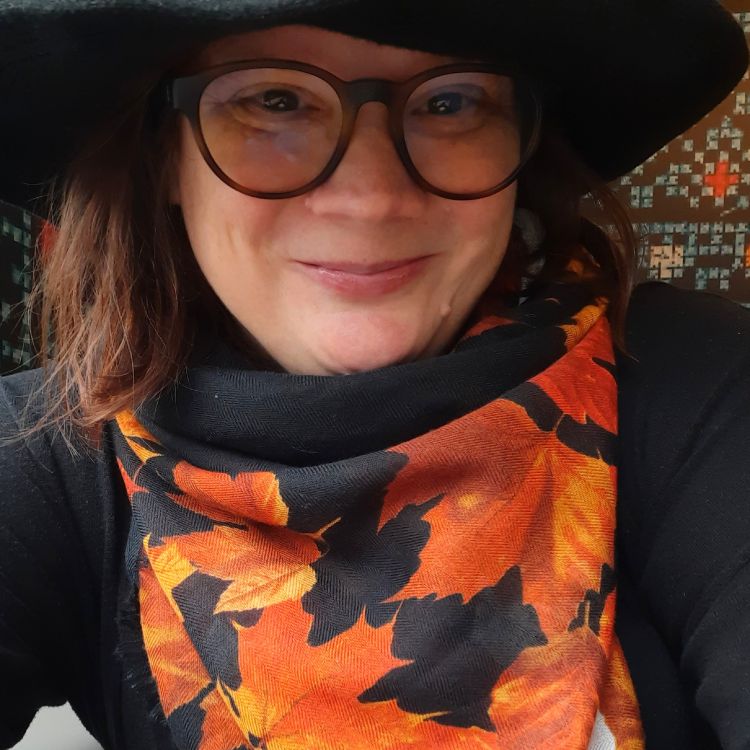
C.G. Aubrey
C.G. Aubrey is a queer, autistic writer and outdoor enthusiast obsessed with yellow leaves, pluff mud, swamp rainbows, and em dashes. She holds masters degrees in US History and Religious Studies and, unsurprisingly, finds both inspiration and frustration at the intersection of cultural memory, religion, and the environment. Her story “A Predatory Transience” appeared in Reckoning Magazine in 2023, and she’s been editing there ever since. Find her occasionally on Bluesky @cgaubrey.bsky.social, Instagram @c.g.aubrey, and www.cgaubrey.com.